
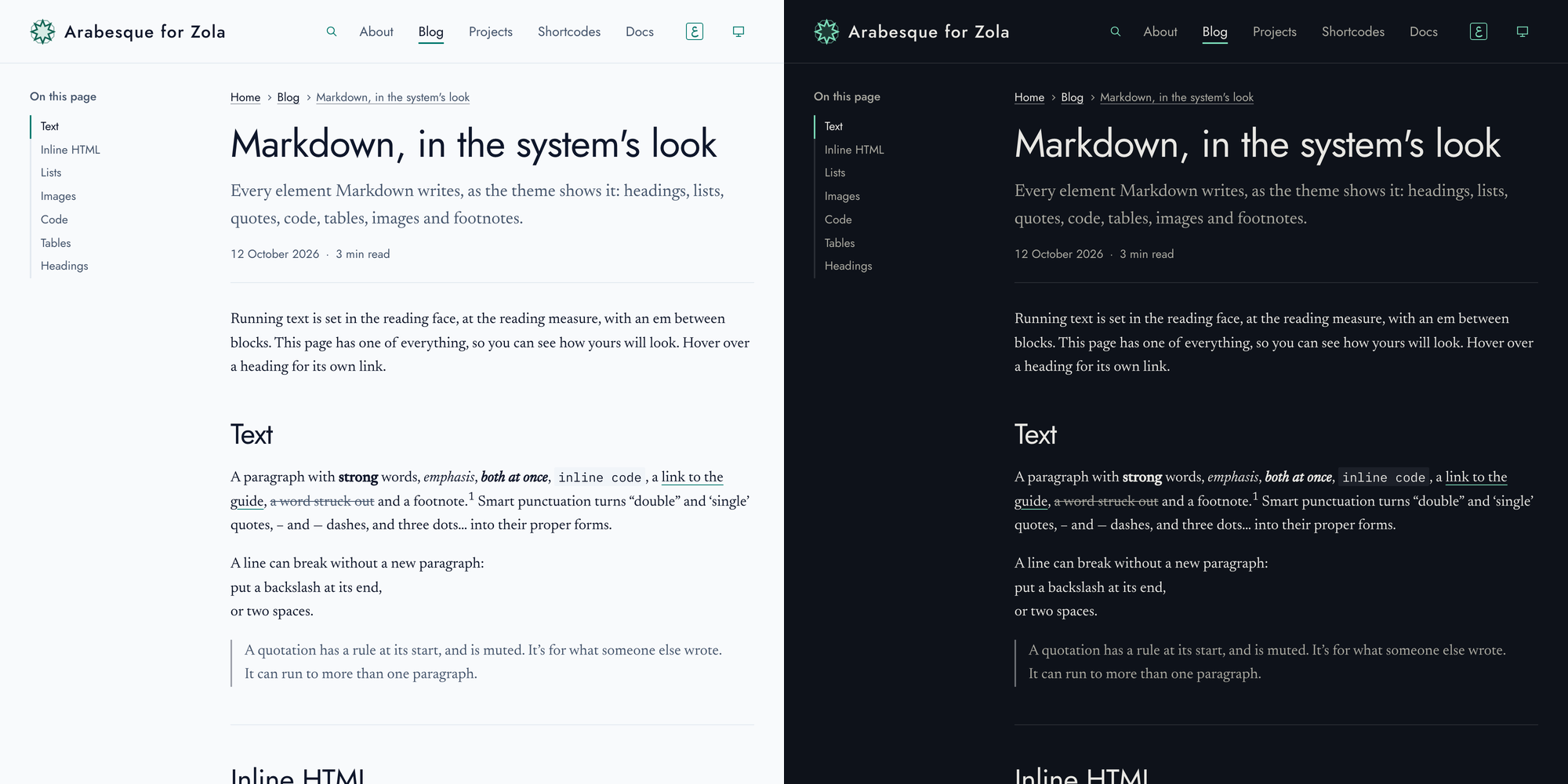

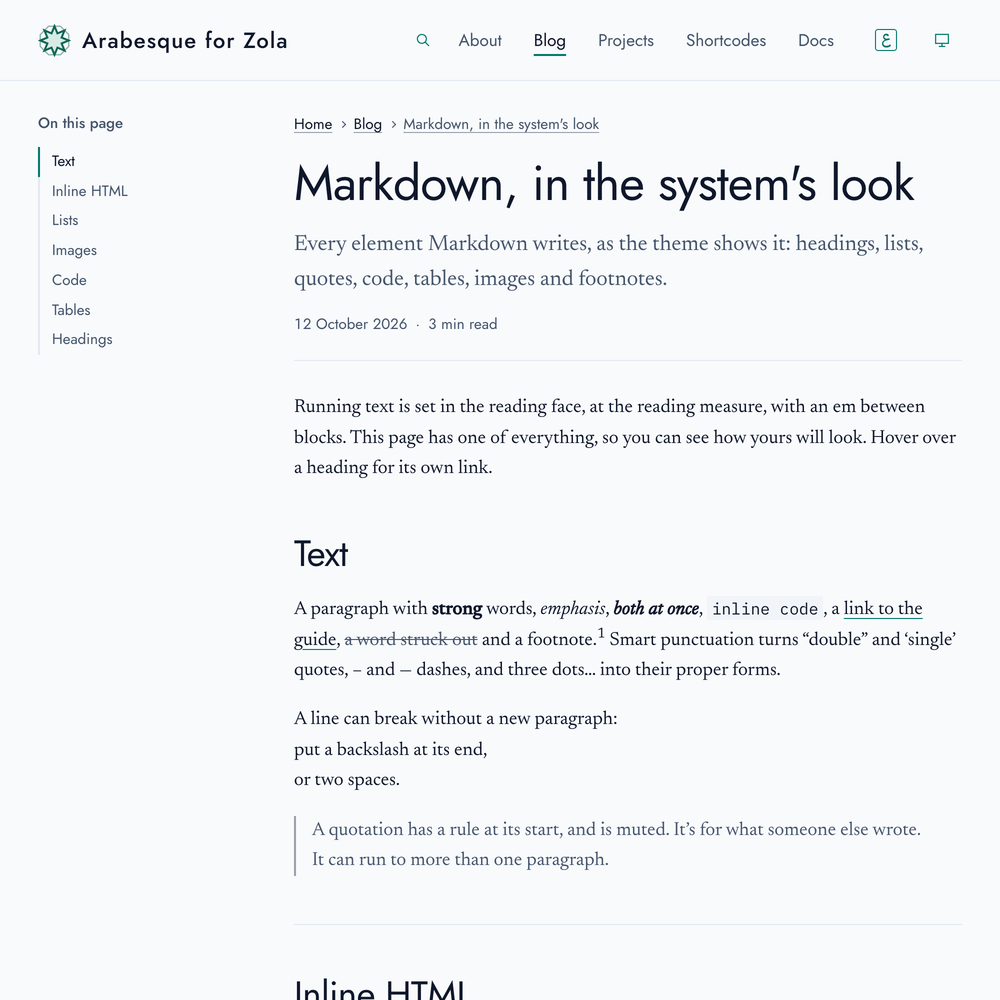
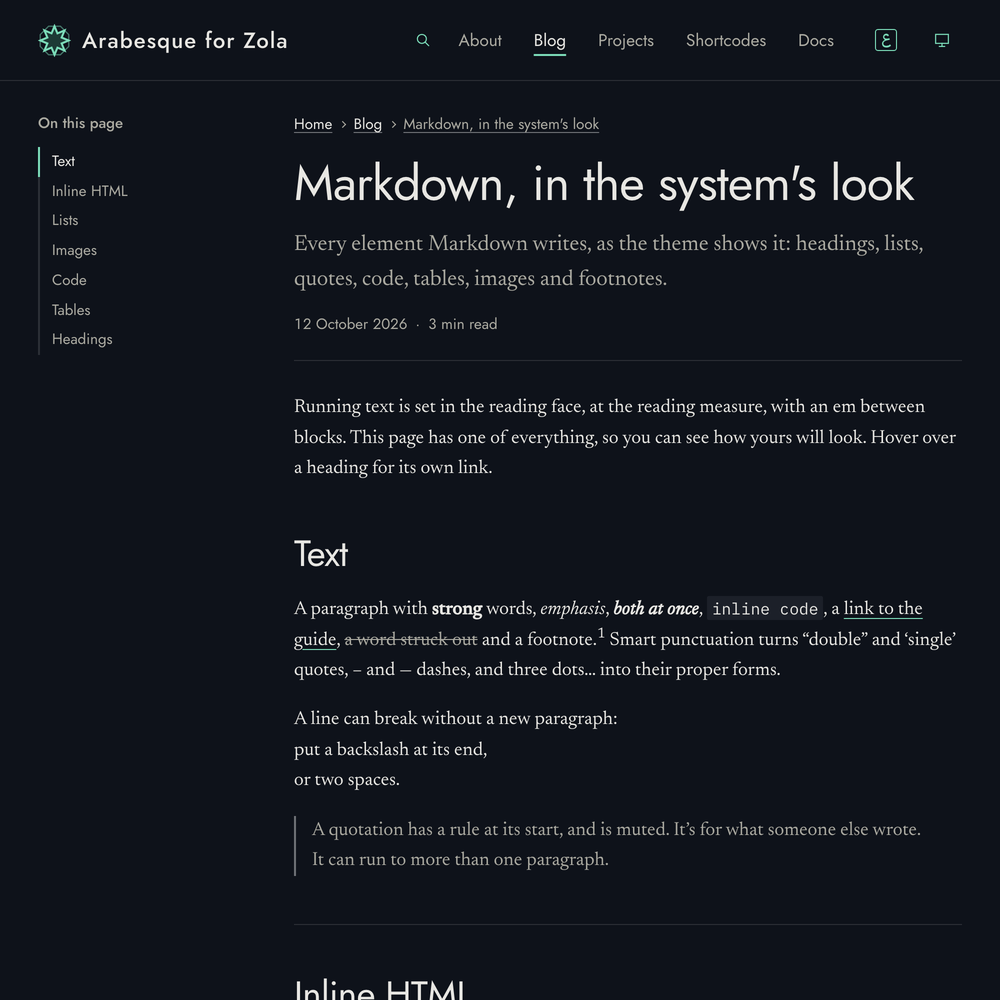
A theme for the static site generator Zola, based on the Arabesque design system: calm, accessible (WCAG 2.2 AA as a floor), and bidirectional, in English and Arabic, light and dark, from the start.
Zola 0.23 or later. In your site:
git submodule add https://github.com/ArabesqueLabs/zola-theme-arabesque.git themes/arabesqueThen in config.toml:
theme = "arabesque"

# Code in the design system's syntax colours, light and dark, as the theme button says.
[markdown.highlighting]
light_theme = "arabesque-light"
dark_theme = "arabesque-dark"
extra_themes = ["themes/arabesque/highlighting/arabesque-light.json", "themes/arabesque/highlighting/arabesque-dark.json"]
add_color_scheme = false
To see every template working, in English and Arabic, clone this repository and run zola serve in it: like the other themes in Zola's gallery, the repository is itself the demo site.
git clone https://github.com/ArabesqueLabs/zola-theme-arabesque.git
cd zola-theme-arabesque && zola serveThe defaults are in theme.toml. To change one, set the same key under [extra] in your config.toml. Tables merge key by key, so you only write what differs; a list replaces the theme's whole. The demo's config.toml sets every key, so it doubles as a full example.
[extra.header]
logo = ""              # an image in static/, shown before the site's title
sticky = true          # keep the header at the top as the page scrolls
theme_toggle = true
language_link = true

# The menu, per language. url is content ("@/…md", in this language), a path, or an address.
[[extra.menu.en]]
name = "Blog"
url = "@/blog/_index.md"

# One action that stays in the bar at every width (optional).
[extra.header.action.en]
name = "Subscribe"
url = "@/subscribe.md"

[[extra.footer.links.en]]
name = "Privacy"
url = "@/privacy.md"

[[extra.footer.links.en]]
name = "Source on GitHub"   # with an icon, the link is the icon, named by this
url = "https://github.com/me/site"
icon = "github"

[extra.footer.text]
en = "Written in London."   # a line under the copyright

[extra.footer.copyright]     # in place of the theme's "© %year %name."; HTML is kept
en = 'Made with ♥ by <a href="https://example.com">Me</a> | © %year'

[extra.footer]
lockup = false     # the site's name (and logo) in the footer too
credit = false     # "Built with Zola and the Arabesque design system."
feed_link = true # an icon linking the Atom feed, after the links (when generate_feeds is on)The hero comes from content/_index.md's front matter; its content follows the hero; then the latest pages of one section.
+++
title = "My site"

[extra.hero]
eyebrow = "Optional words above the title"
title = "One sentence that says what this is."
lede = "One or two more."               # the section's description by default
caption = "What the teal tile is."     # under the pattern's focal tile (optional)
actions = [
  { name = "Start here", url = "@/docs/_index.md" },      # the primary button
  { name = "Read the blog", url = "@/blog/_index.md" },   # text links after it
]
links = [                                                 # icon links under them
  { name = "GitHub", url = "https://github.com/me/site", icon = "github" },
  { name = "Atom feed", icon = "feed" },                  # the feed in this language
]
+++
A logo or a profile picture takes the place of the pattern's teal focal tile (on a phone, it sits above the title):
[extra.hero]
image = "logo.svg"           # in static/, or an address; photos are resized by Zola
image_alt = ""               # empty for a logo the title already names; a description for a photo
image_style = "logo"         # "logo" (as it is, the default) or "portrait" (cropped to a circle)
# initials = "LH"            # with no image: initials in a circle, as a placeholder
                             # (a portrait with neither shows an anonymous profile picture)
# tint = "teal"              # the placeholder's colours: teal, blue, green, yellow, orange,
                             # pink, purple or cyan; neutral greys without one
A portrait sits in a halo: a ring of the page's background with a hairline, which clears the pattern around it (the design system has no drop shadows). The placeholder is drawn in the page, in the theme's colours, so it follows the theme button. To change any of it, set these in your own stylesheet (extra.stylesheets):
.zt-hero {
  --zt-hero-halo: 0.875rem;                          /* the ring's width; 0 for none */
  --zt-avatar-ground: var(--al-color-surface-sunk);  /* the placeholder's circle */
  --zt-avatar-figure: var(--al-color-line-strong);   /* the placeholder's figure */
}[extra.home]
section = "blog/_index.md" # "" (the default) for none
count = 5
pattern = true # the drawn pattern behind the hero
animate = true # it draws itself in once (never under reduced motion)| Key | Default | Does |
|---|---|---|
extra.page.toc_min_headings | 4 | "On this page" for a page with this many h2s; 0 for never |
extra.page.reading_time | true | Minutes to read, beside the date |
extra.page.page_nav | true | The pages either side: Newer and Older by date, Previous and Next otherwise |
extra.page.back_to_top_after | 0.5 | Show "Back to top" once the page has scrolled this many screens |
In a page's front matter, under [extra]: toc = true | false overrides the contents, and image = "cover.png" (beside the page, in static/, or an address) is its social image, with image_alt for its alt text. draft = true adds a Draft badge; authors = [...] names who wrote it.
Each page describes itself to the sites and apps that preview links (Open Graph, for Facebook, LinkedIn, Slack, Discord, Mastodon and most others; X's cards) and to search engines (schema.org JSON-LD: the site on the home page, a BlogPosting for each dated page, a WebPage or CollectionPage for the rest). With nothing set, the tags use each page's title, description, date, tags, authors and image, then the site's.
[extra.social]
image = "social.png"                     # for pages without their own; best at 1200×630
image_alt = "The site's name on the pattern"
twitter_site = "@site"
twitter_creator = "@you"
fediverse_creator = "@you@example.social"
publisher_type = "Person"                # or "Organization"
same_as = ["https://github.com/you"]| Key | Default | Does |
|---|---|---|
extra.social.enabled | true | All of the tags; false for none |
extra.social.image | "" | The image shared with a page that has none of its own: in static/, or an address |
extra.social.image_alt | "" | What that image shows |
extra.social.twitter_site | "" | The site's X account, "@name" |
extra.social.twitter_creator | "" | The author's X account |
extra.social.fediverse_creator | "" | The author's fediverse account, "@name@example.social": Mastodon credits it on shared links |
extra.social.schema_org | true | The schema.org data |
extra.social.publisher_type | "Person" | Who publishes the site: "Person" or "Organization", named by extra.author, then author, then the title |
extra.social.same_as | [] | Your profiles elsewhere, for schema.org's sameAs |
| Key | Does |
|---|---|
extra.search.page | The search page ("@/search.md"); adds a search button to the header |
extra.favicon | Your icon, in static/; the pattern's star by default |
extra.author | Who the copyright line names; author, then title, by default |
extra.stylesheets | Your own CSS files, in static/, loaded after the theme's |
extra.rtl_languages | Languages written right to left |
extra.language_names | Each language, named in itself (ar = "العربية"): the language link's name |
extra.language_glyphs | Each language's letter, shown in a key as the language link (ar = "ع", en = "En"); the translate icon for a language without one |
extra.i18n.<lang> | The words the theme writes, per language |
Zola's own: index.html, section.html, page.html, taxonomy_list.html, taxonomy_single.html and 404.html. Two for a section of projects:
projects.html and project.html: a section's pages as cards, each with its picture (or its first letter on the quiet pattern), summary, year, and links to its site and source; then each subsection's, under its title. On a project's own page, the year and links sit under its title, with the picture below them.
+++
title = "Projects"
sort_by = "weight"
template = "projects.html"
page_template = "project.html"
+++
and in each project's front matter, all optional:
[extra]
image = "cover.jpg"   # beside the page (a page bundle), in static/ ("/img/x.png"), or an address
image_alt = ""        # on the project's own page; the card's picture is decoration
year = "2024"
website = "https://example.com"
source = "https://github.com/me/project"   # a GitHub address gets GitHub's mark
And two for a page's template:
archive.html: every page of a section by year. [extra] section = "blog/_index.md"; the home page's section by default.
search.html: search in the browser over Zola's index, as people type, with the query in the address (?q=). Arabic is matched without its vowel marks, and with its letter variants folded. For each language:
build_search_index = true

[search]
index_format = "fuse_json"   # indexes Arabic as well as English; elasticlunr can't

[extra.search]
page = "@/search.md"
and content/search.md (and search.ar.md …) with template = "search.html".
To change a template, copy it to your site's templates/ with the same name; or extend the theme's and replace a block (title, head, top, main, scripts):
{%/* extends "arabesque/templates/page.html" */%}
{%/* block scripts */%}<script src="/my.js" defer></script>{%/* endblock */%}Zola's components (since 0.23), to write in Markdown: {{/* <name … /> */}}, or {%/* <name …> */%} and {%/* </name> */%} around Markdown. A value that isn't a string goes in braces: values={["8", "19"]}, open={true}.
| Component | Writes |
|---|---|
{%/* <notice kind="warning" title="…"> */%}Markdown{%/* </notice> */%} | A notice: info (default), success, warning, danger (errors only) |
{%/* <details summary="…" value="…" open={false}> */%}Markdown{%/* </details> */%} | A disclosure, with a value shown while closed |
{%/* <quote name="…" role="…"> */%}Their words{%/* </quote> */%} | A quote, with who said it |
{%/* <code caption="config.toml"> */%} a fenced block {%/* </code> */%} | A code block with its file's name in the bar |
{{/* <command text="zola serve" /> */}} | One line to paste into a terminal, with a copy button |
{{/* <stats labels={[…]} values={[…]} notes={[…]} /> */}} | Two to four figures, side by side |
{{/* <steps titles={[…]} bodies={[…]} /> */}} | Numbered stages |
{{/* <cta title lede url text url2 text2 /> */}} | A call to action on the quiet pattern |
{{/* <button url text style="primary" /> */}} | A link as a button: primary, default, or arrow (a text link) |
{{/* <badge text kind /> */}} | A status in a word: neutral, accent, success, warning, danger, info, outline |
{{/* <kbd keys="Ctrl+K" /> */}} | Keys to press |
{{/* <figure src alt caption width height /> */}} | An image with its caption |
{{/* <gallery alts={[…]} columns={16} /> */}} | The images beside a page (a page bundle), as thumbnails Zola makes |
{{/* <separator style="star" gap="lg" /> */}} | A break between scenes: 15 styles (asterisks, dots, arabic, star, rule, gradient…), with gap, size, width, color |
{%/* <mermaid label="…"> */%}flowchart LR…{%/* </mermaid> */%} | A Mermaid diagram in the theme's colours, redrawn when the theme changes (Mermaid loads from jsDelivr, on that page only) |
{{/* <youtube id playlist start title /> */}} | A YouTube video or playlist, 16:9, from the no-cookie domain |
{{/* <pdf src title height /> */}} | A PDF in the page, with a link to download it |
{{/* <gist user gist file /> */}} | A GitHub Gist (GitHub's script), with a link without JavaScript |
{{/* <instagram id /> */}} | An Instagram post (Instagram's script), a link until it loads |
The demo's Components page shows each one, and Galleries, diagrams and embeds the last seven working. To change one, write a component of the same name in your site's templates/ (copying the theme's from templates/components/ is a start): yours is used instead.
default_language = "en"

[languages.ar]
title = "موقعي"
Write each page's translation beside it (about.md, about.ar.md). A language in extra.rtl_languages is set right to left. The theme's words are in English and Arabic; for another language, add [extra.i18n.<code>] with every key in the theme's [extra.i18n.en], including date_format and date_locale. A language without one uses the English words.
templates/              the templates, partials/ and components/
highlighting/           the code's colours, light and dark, as Zola highlighting themes
static/arabesque/       the design system, copied unchanged: arabesque.css, icons.svg, fonts/, js/ (VERSION says which)
static/arabesque/theme/ the theme's own: theme.css (layout, Markdown, syntax colour), theme.js, search.js, favicon.svg
config.toml, content/   the demo site (used only when you serve this repository itself)
scripts/vendor-arabesque.sh   copies a released design system version into static/arabesque/
theme.css follows the design system's rules: tokens only, logical properties only. Its classes start zt-; the system's, al-. It's unlayered, so it wins over the system's layers, and your own extra.stylesheets win over both.
To move to a newer design system: scripts/vendor-arabesque.sh 0.10.0, then read its changelog: before 1.0, a minor version may rename or remove classes.
The theme is MIT licensed, as is the design system's code in
static/arabesque/ (its licence). The fonts keep
their own licences, the SIL Open Font License 1.1, whose texts are beside them
in static/arabesque/fonts/.