
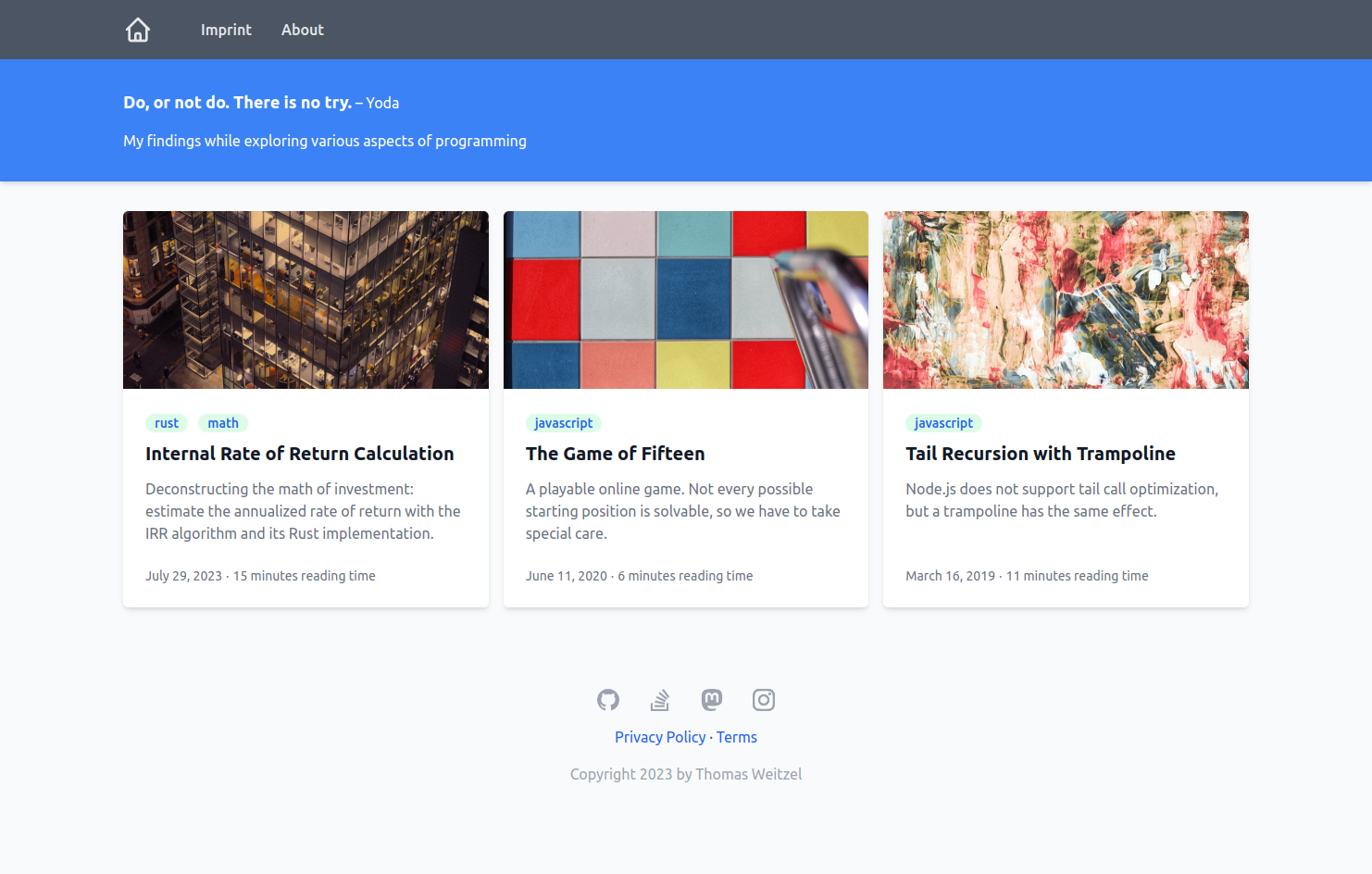
Zolarwind is a Zola blog theme with Tailwind CSS, KaTeX, and Mermaid support. It targets blogs that want Tailwind-based styling, diagrams, and math rendering. Localization is built-in for a single-locale build.
GDPR-clean by default: No third-party requests, no cookies, no tracking. All JS/CSS is self-hosted, so no consent banner is required for a default Zolarwind site.
Tailwind CSS: Use Tailwind for layout and UI.
Mermaid Integration: Render diagrams from text.
KaTeX Integration: Render math formulas in posts.
Localization Support: Theme strings live in language files; pick the one you want. If your language isn't supported yet, just create the resource file with your translations.
Dark/Light Mode: Includes a dark/light toggle and persists the preference for the session after a user toggle.
Client-side Search: Built-in search page powered by Zola's index and MiniSearch.
Series Support: Group posts into a series taxonomy with ordered navigation on series posts.
Artalk Comments: Optional integration with a self-hosted Artalk server. See docs/artalk.md.
As of Zola v0.23.5, released on 2026-09-12, Zolarwind's locale-specific settings_date_format values are no longer
compatible with Zola's date filter. Zola v0.23.5 updates Tera to v2.3.0, which includes tera-contrib v0.3.0.
The tera-contrib v0.3.0 changelog describes the relevant change as: "Add locale parameter to date filter using
UTS-35 datetime patterns."
As a result, locale-specific date formats now use UTS-35 patterns instead of the strftime patterns previously used by Zolarwind. Zolarwind's date format settings have therefore been updated accordingly. This change is required for the theme to work with Zola v0.23.5, but makes it incompatible with earlier Zola versions.
You can see the theme on the demo website. Additionally, there is a demo in German.
To use the theme, you need the following software installed:
Git, required for version control.
Node.js, an open-source, cross-platform JavaScript runtime environment. Node.js is
optional. It is only needed if you want to change the CSS in css/main.css. The theme comes with pre-compiled CSS
and is fully functional without Node.js.
Zola, a static site generator. This is the only absolute requirement to build your site with Zolarwind.
If you want to use this repository as the base for your new blog, this is the fastest way:
Clone the repository:
git clone https://github.com/thomasweitzel/zolarwind.git
cd zolarwind
Run the site:
zola serveNow open the link provided by zola serve in your browser.
Configure:
Adjust base_url and other settings in zola.toml to your needs.
If you already have a Zola site and want to use Zolarwind as a theme in your themes/ folder, please refer to
the Integrating the theme folder section for detailed instructions or to use the
automated script.
Your zola.toml file controls customization for the Zola site.
Configuration settings used by this theme:
base_url: Specify the URL the site will be built for.
In this case, the site will be built for https://example.org.
Adjust this to your own domain.
compile_sass: Determines whether to automatically compile all Sass files present in the sass directory.
Here, it's set to false, meaning Sass files won't be automatically compiled for this theme.
default_language: Sets the default language for the site.
The provided config uses English (en) as the default language.
As of now, German (de) is available in the i18n directory.
theme: The theme used for the site.
The provided line is commented out, indicating that the theme's files are taken from the templates directory.
If you move the theme to the themes/zolarwind directory, use zolarwind for this entry.
build_search_index: If set to true, a search index will be built from the pages and section content for the default_language.
In this configuration and for this theme, it's enabled (true).
generate_feeds: Determines if an Atom feed (file atom.xml) is automatically generated.
It's set to true, meaning a feed will be generated.
taxonomies: An array of taxonomies (classification systems) used for the site.
Here, tags (feed enabled) and series (feed disabled) are defined, each with a pagination limit of 6.
light_theme and dark_theme: The themes used for code highlighting in light and dark mode.
Zola generates giallo-light.css and giallo-dark.css in the build output.
Templates load both files and the theme toggle enables the matching stylesheet.
If you want the same style in both modes, set both to the same theme.
Zolarwind expects both values to be set, because the highlight files are loaded on templates that render Markdown content (posts/pages).
If you add code blocks directly in other templates, include the highlight files there as well.
error_on_missing_language: If the language to be highlighted is not found, how should Zola handle this? Set to true so missing languages cause a build error.
style: How to highlight code. Options are either class or inline. Here, we use the setting class.
extra_grammars: array of additional TextMate grammar files in JSON format for languages not bundled with Zola/Giallo. This theme includes the upstream Caddyfile grammar in syntaxes/caddyfile.tmLanguage.json as a working example; its MIT license is in syntaxes/caddyfile.LICENSE.
The [extra] section is where you can place any custom variables you want to be accessible in your templates.
title: Required. The title of the site. Here, it's set to "Zolarwind."
path_language_resources: Required.
The path to the directory containing language resource files.
In this config, it's set to i18n/.
If you move the theme to the themes/zolarwind directory, use themes/zolarwind/i18n/ for this entry.
generator: Optional.
Specify the generator used for creating the static website.
This site is generated using Zola v0.22.1.
favicon_svg: Optional.
Provides a path to the site's favicon in SVG format.
The provided path points to /img/yin-yang.svg.
copyright: Optional.
A template for the copyright notice.
It includes a placeholder {year} which is dynamically replaced with the current year of your zola build run.
site_description: Optional. A brief description is displayed on the site's banner.
quote: Optional. A structure defining a quote and its author. This quote is from Yoda.
menu_pages: Optional.
An array of main navigation menu items.
Each item has a title and a url.
footer_pages: Optional.
An array of pages that will appear in the site's footer.
Each item has a title and a url.
social_links: Optional. An array of social media links. Each link has a name, a boolean indicating if it's enabled, a URL, and an SVG icon.
toc: Optional.
Default toggle for the in-page table of contents when a page does not set extra.toc in front matter.
Defaults to false when omitted.
toc_levels: Optional.
Default heading level range for the in-page table of contents.
Defaults to { min = 2, max = 3 } when omitted.
Valid range is 1..6 and min must be <= max (values are clamped to this range).
displaymode.sun and displaymode.moon: Optional. Inline SVG icons used by the dark/light mode toggle. Define both to enable the toggle; if either is missing, the toggle is not rendered.
This theme is safe to run under a subpath (for example https://example.org/blog/), as long as all internal links and
assets are resolved with Zola's get_url helper. That is why the templates use get_url for CSS, JS, images, and menu
links. Keep internal links in zola.toml root-relative (for example "/pages/about/"), so Zola can prefix the
base_url subpath reliably.
If you add or adjust templates, avoid hardcoded href="/..." or src="/...". Always prefer:
{{/* get_url(path="/img/example.jpg") */}}zola serve always mounts at /, so it does not exercise subpath behavior. To test subpaths locally, build into a
subdirectory and serve the output from there:
zola build --base-url http://127.0.0.1:1111/demo/zolarwind -o public/demo/zolarwind
python -m http.server --directory public 1111
python -m http.server is only an example static file server; any server that can serve public/ works (for example Apache, Nginx, or static-web-server).
Then open the link provided by the server in your browser.
For blog posts (Markdown files in folder content/blog), each post has its own folder.
This structure keeps all resources for a post in one place, including images, videos, and other files.
Each post is associated with an image displayed on the blog's main page and on the post's detail page.
If you do not provide an image under extra.image, a default image is used instead.
You can copy and paste this into a new post (e.g., content/blog/perception-vs-math/index.md):
+++
date = 2026-02-05
title = "Intuition vs. mathematical facts"
description = "Examine the reliability of tests using probability trees and Bayes' theorem."
authors = ["Jane Doe"]

[taxonomies]
tags = ["math", "statistics"]

[extra]
math = true
diagram = true
image = "banner.jpg"
+++date: the date of the blog posts, e.g. 2026-02-05.
title: the title of the blog posts, e.g. Intuition vs. mathematical facts.
description: the description of the blog posts. It is used as a summary on the blog's main page.
authors: an optional array of all the post's authors, e.g. ["Jane Doe"].
You can leave it empty, but then the first author will show up as Unknown in the feed (atom.xml).
taxonomies: optional tags and series taxonomies are supported.
Tags are shown on posts and tag index pages, series are shown on series pages and the series navigation at the bottom of series posts.
extra.math: either false (default) or true.
If set to true, the post will be rendered with KaTeX support for inline and display math formulas.
If the entry is omitted or set to false, the post will not have KaTeX support.
Use the KaTeX component and omit $, $$, \(, and \[ delimiters inside its body. Use inline={true} for inline math:
{%/* <katex> */%} a^2 + b^2 {%/* </katex> */%}
{%/* <katex inline={true}> */%} E = mc^2 {%/* </katex> */%}extra.diagram: either false (default) or true.
Controls loading of the necessary JavaScript to render the Mermaid diagram.
If set to true, the post will be rendered with Mermaid support for displaying diagrams
by using the diagram component.
extra.toc: either false (default) or true.
Enables the in-page table of contents for this post/page.
If omitted, the global extra.toc default is used.
For a consistent TOC, start content headings at ## and then nest only in ascending order (## → ### → #### → ##### → ######).
extra.toc_levels: Optional.
Per-page override for the heading level range used by the table of contents.
When omitted, the global extra.toc_levels default is used.
Values outside 1..6 are clamped.
extra.image: an optional image for the post. If omitted, a default image is used instead. The image is displayed on the blog's main page and on the post's detail page.
Zolarwind supports series via Zola taxonomies. Series navigation appears at the bottom of posts that belong to a series.
Enable the taxonomy in zola.toml:
taxonomies = [
    { name = "tags", paginate_by = 6, feed = true },
    { name = "series", paginate_by = 6, feed = false },
]
Series feeds are less commonly consumed than post/tag feeds, so the default disables it to keep output minimal; enable it if you want subscribers to follow series pages.
Assign a post to a series:
[taxonomies]
series = ["my-series"]
Optional ordering: set extra.series_order in the post front matter. When omitted, the series list falls back to the post date.
Series index pages are available at /series/ and /series/<name>/.
Note: If no posts use the series taxonomy, Zola does not generate /series/, so it will 404.
Zolarwind provides Markdown-facing components, stored in templates/shortcodes/. Use them when you want the feature, not as formatting helpers.
Full documentation with parameters and examples: docs/shortcodes.md.
<audio> player in a themed card.This theme ships with a local, client-side search page powered by Zola's search index (Elasticlunr output) and MiniSearch.
zola.toml:build_search_index = truecontent/pages/search.md). If your content/pages/_index.md
uses sort_by = "date", the page needs a date (or weight) to avoid being ignored. You can optionally set
extra.results_per_page to control pagination and extra.pagination_window to control the number of pages shown on each side of the current page.+++
date = 2026-01-14
title = "Search"
template = "search.html"
[extra]
results_per_page = 5
pagination_window = 2
+++/pages/search/.
Note: The search icon is only rendered when build_search_index = true.When using this theme in another Zola site, add content/pages/search.md in that site repository. Theme content/ is not loaded by Zola.
The search index is built for the current default_language only.
Note: If build_search_index = true but you don’t create content/pages/search.md, the search link will 404.
Consider this text on a page where a blog post is published as an example: Published on July 04, 2023; 1,234 words.
If your blog is in the German language, you want to have Veröffentlicht am 04. Juli 2023; 1.234 Wörter instead.
Not only the text should be translated, but also the date and number formats are different.
And you want a text like 1 word or 1 Wort, because the singular form should be used where applicable.
This theme takes care of that.
To localize your blog with this theme:
Pick your desired language by setting the default_language in zola.toml.
As of now, English (en) and German (de) have language resources available in the i18n directory.
If your language is not supported yet, just create a new resource file with your translations.
Use the file en.toml as a template for your own translations.
Use the correct language code for the file name, e.g. eo.toml for Esperanto.
This theme supports only languages that read from left-to-right (ltr).
The theme will automatically display all theme-specific string resources in the chosen language.
The content that you provide should match this language. But that is your responsibility. The theme will not translate your content.
This theme uses default_language as a build-time switch for a single locale per build.
It does not target Zola's multi-language output in a single build.
If you need to define your own date format, look here for supported specifiers.
This repository is a standalone Zola site by default. If you want to integrate Zolarwind into an existing Zola website as a theme, you have two options:
There is a helper script, integrate-theme-folder.sh, which performs all the necessary file moves and configuration
updates automatically (tested on Linux/Bash).
Note: Run it only on a fresh checkout of Zolarwind, as it moves and edits files in place.
./integrate-theme-folder.shThis section is for those who prefer to move files manually or are on a non-Linux system.
You can integrate the theme by moving the relevant theme files to the themes/zolarwind directory.
All other files stay in the root directory.
If you have your own files there, you need to merge them with the ones from this theme.
You also need to adjust the zola.toml and package.json files in the root accordingly.
Most extra.* settings are optional (except title and path_language_resources), but if omitted the related UI
elements won’t render (menu, footer links, social icons, or the theme toggle). If search is enabled, add
content/pages/search.md in the site repository. Theme content/ is not loaded by Zola (see the Search
section).
The manual integration section shows the directories that need to be moved. This is the directory structure of the standalone site, where the theme is in the root directory:
/
├── css
├── i18n
├── static
│   ├── css
│   ├── img
│   └── js
├── syntaxes
├── templates
└── theme.toml
Create a new directory themes/zolarwind and move the theme-specific files there. The tree below shows what stays in the site root and what moves under themes/zolarwind:
/
├── static
│   └── css
├── syntaxes
└── themes
    └── zolarwind
        ├── css
        ├── i18n
        ├── static
        │   ├── img
        │   └── js
        ├── templates
        └── theme.toml
The directory syntaxes stays in its original location. If you want to move it, you have to adjust the extra_grammars entries in zola.toml.
The static/css directory is a special case.
It contains the generated Tailwind CSS file with the name generated.css.
It will stay in its original location.
Zola always serves the site’s static/ directory, even when a theme is used.
This file is generated from the file css/main.css, which is the input for the CSS generation.
Zola generates giallo-light.css and giallo-dark.css in the build output from the configured highlighting themes; they are not source files that need moving during integration.
The generation process can be triggered with a script in the package.json file.
You only need to adjust and run the script in package.json if you make changes to the theme's template files or use new Tailwind CSS classes directly in your content files.
Since the source file css/main.css has moved to the directory themes/zolarwind/css/main.css, we need to adjust the script in package.json accordingly.
This is what the relevant part of it looks like for the stand-alone site:
"scripts": {
  "css:build": "npx tailwindcss -i ./css/main.css -o ./static/css/generated.css --minify",
  "css:watch": "npx tailwindcss -i ./css/main.css -o ./static/css/generated.css --watch",
  "server": "zola serve"
}
Now change it so that the input file css/main.css will be the file themes/zolarwind/css/main.css:
"scripts": {
  "css:build": "npx tailwindcss -i ./themes/zolarwind/css/main.css -o ./static/css/generated.css --minify",
  "css:watch": "npx tailwindcss -i ./themes/zolarwind/css/main.css -o ./static/css/generated.css --watch",
  "server": "zola serve"
}
Since you now use Zolarwind as a theme, you need to declare it in the zola.toml file.
The theme's files have moved to the directory themes/zolarwind, so you need to adjust the only reference to the theme's files in the zola.toml file accordingly by changing the path_language_resources entry:
# The site theme to use
theme = "zolarwind"

# ...

# Path to the language resource files
[extra]
path_language_resources = "themes/zolarwind/i18n/"To customize the CSS, edit the files in the templates and css directories.
Ensure that the CSS file static/css/generated.css is updated.
This file is generated from css/main.css and the files identified via automatic content detection.
The theme uses a custom color palette (neutral, primary, ok, warn, fail) instead of the default Tailwind colors.
When new classes are added in templates or content, rebuild the CSS to include the generated palette classes.
If a source file is excluded by default, it can be added with the @source directive in css/main.css:
@source "../node_modules/@my-company/ui-lib";When these files change, run the css:build script from package.json. This requires Node.js and the dependencies
from package.json (installed with npm install). Running npm run css:watch monitors the files and triggers CSS
generation on changes. This ensures static/css/generated.css remains current.
It is recommended to have two terminals open: one for the Zola server (zola serve) and another for the CSS watch
script (npm run css:watch). The browser reloads with updated CSS when files are modified.
This theme sets no cookies and does not load resources from third-party sites. The dark/light mode preference is stored in sessionStorage only after a user explicitly toggles the theme.
KaTeX, Mermaid, and MiniSearch are bundled in static/ so they can be served from your own domain and remain pinned to known versions.
If you instead load them from a Content Delivery Network (CDN), consider the following GDPR implications:
Third-Party Requests & Data Privacy: When you load resources from a CDN, it triggers third-party requests to the CDN's servers. These servers might log your IP address, user agent, and other request-related metadata. Under GDPR, IP addresses can be considered personal data. By serving these libraries from your domain, you reduce third-party data transfers, limiting the amount of personal data you expose to external entities.
Cookies: Many CDNs set cookies for various reasons, including analytics or performance optimizations. These cookies can track users across different websites that use the same CDN, potentially infringing on their privacy rights. By hosting these libraries on your domain, you control cookies and can ensure compliance with GDPR.
Consent: If you're using a CDN that sets cookies or collects data, you might need to get explicit user consent before loading resources from that CDN. This can complicate user experience and lead to a reduced site performance for users who opt-out. By self-hosting, you circumvent this issue.
Transparency & Control: By self-hosting, you know exactly which versions of these libraries you're using and can ensure there are no modifications or unexpected behaviors. With CDNs, there's a risk of the library being compromised, which could affect all sites using that resource.
Data Transfer Outside the EU: If the CDN servers are located outside the European Union, you might be transferring data out of the EU, which adds another layer of GDPR compliance requirements. By self-hosting, you ensure that user data doesn't leave the region unless you specifically choose a hosting solution outside the EU.
This theme does not use @tailwindcss/typography for styling of Markdown files.
Instead, it uses @apply in the css/main.css file.
The @apply directive in Tailwind CSS enables composing utility classes into custom CSS classes.
This allows applying multiple utility styles within a single class for Markdown content styling.
This approach provides control over the visual result.
It requires manual styling instead of using the @tailwindcss/typography plugin.
This recreates common typographic patterns that the typography plugin already provides.
Contributions are always welcome! If you see areas of improvement or want to add features, please submit a PR.
I'm especially interested in more translations.
See folder i18n for what's available and what is not.
Use the file en.toml as a template for your own translations.
This theme is under the MIT License. For details, please refer to the LICENSE file.